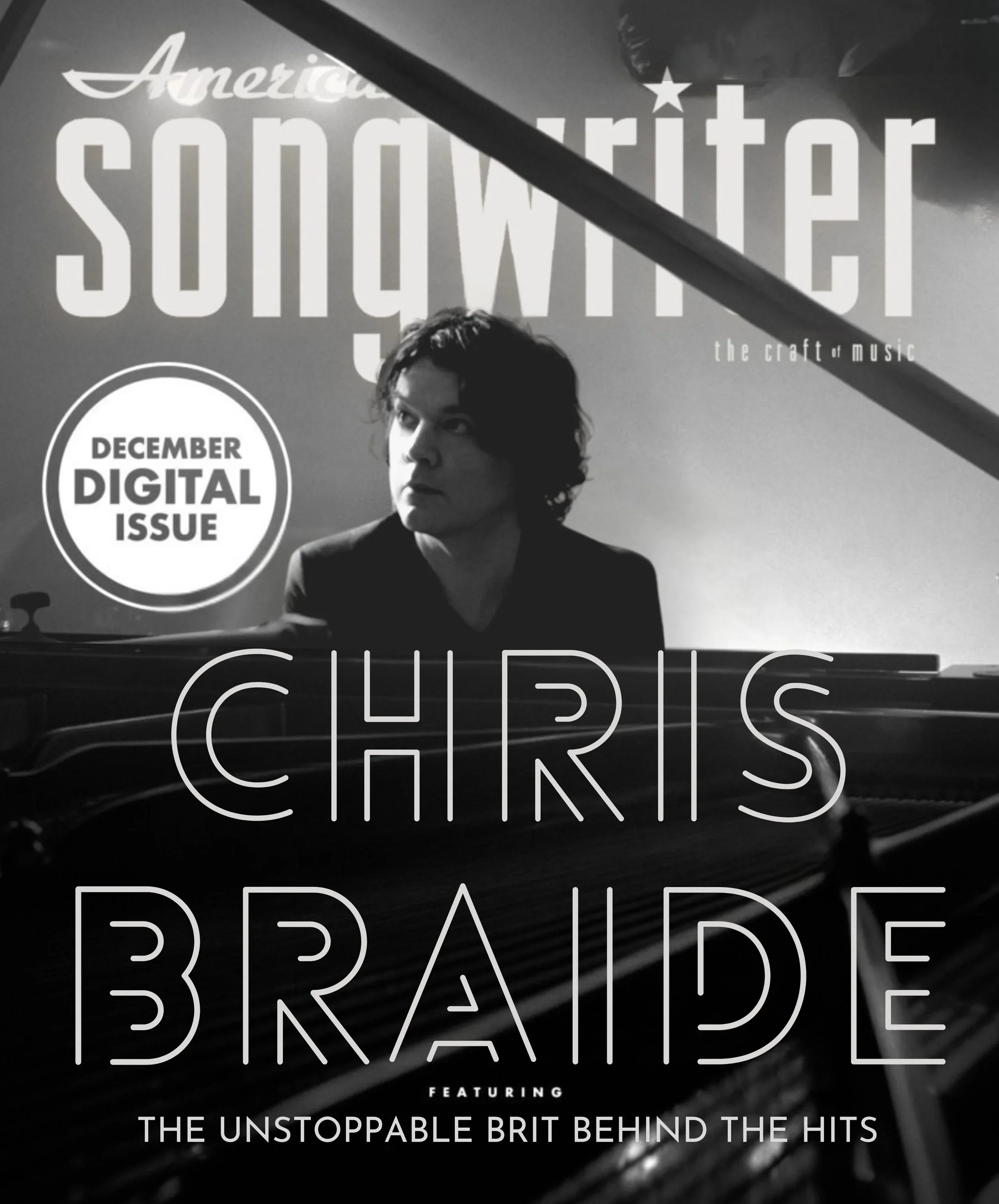
Chris Braide: The Long Game of the Song
What links Sia with David Guetta, Lana Del Rey with Hans Zimmer, Beyoncé with an English piano player raised on hymnals and The Beatles? Why, the songs of Chris Braide — one of modern pop’s most quietly omnipresent writers.
From chart-topping anthems like “Unstoppable,” “She Wolf (Falling to Pieces),” “Flames,” “Big Girls Cry,” and “Out There,” to more introspective albums released under his own name, Braide’s work exists in a rare space: hugely successful, yet deeply private. Over the past three decades, his songs have been sung by artists who define eras, yet his own voice — literal and metaphorical — has remained something of a secret.
Here, in conversation with American Songwriter, Braide reflects on craft, collaboration, and a career built less on spectacle than on persistence.
The Songwriters Life
Ask Chris Braide what has sustained him through a career marked by extreme highs and quieter, more internal seasons, and his answer is immediate.
“Work. Just work,” he says. “You show up. You keep writing. You don’t wait for permission.”
Born in England and shaped early by classical piano, church music, and the melodic discipline of Lennon and McCartney, Braide came of age musically in the late ’80s and early ’90s, a time when songcraft still mattered as much as sound. After early solo releases and sessions with artists like Dave Stewart, Thomas Dolby, and Mick Hucknall, he learned quickly that longevity in music depends less on being visible than being useful.
“Some people want to be the event,” he says. “I wanted to be the song.”
Hits Without a Persona
Braide’s breakthrough as a pop songwriter didn’t arrive with a single lightning bolt moment, but through accumulation. By the time Sia recorded Unstoppable, he had already spent years refining a writing philosophy rooted in emotional clarity.
“Sia and I connected immediately because neither of us was interested in irony,” he says. “We wanted songs that meant something — songs that could survive different interpretations.”
That philosophy carried him through collaborations with Desmond Child, David Guetta, Lana Del Rey, Theophilus London, Hans Zimmer, and others — each partnership different, but unified by Braide’s insistence that melody and emotional truth remain central.
“There was a period when people said melody was over,” he says, smiling. “I just ignored that. Melody is how people remember their lives.”
The Art Of Coolaboration
Working with Desmond Child taught Braide something essential about pop writing: bravery.
“Desmond has this fearless relationship with emotion,” he says. “He doesn’t hide behind cleverness. That was important for me to witness.”
His long association with Dave Stewart offered something else — instinct and spontaneity.
“Dave works fast,” Braide says. “You learn not to overthink. Some of the best things happen before your inner critic wakes up.”
These experiences shaped Braide into a songwriter who values trust over control — an unusual position in an industry obsessed with authorship and credit.
“I never believed the song belonged to me alone,” he says. “Once it exists, it belongs to whoever needs it.”
The Quiet Albums
While his commercial work placed him at the center of global pop, Braide never stopped recording under his own name — albums that function more like journals than statements.
“These records aren’t strategic,” he admits. “They’re necessary.”
Recent releases reflect a man less concerned with validation than coherence — someone circling themes of memory, identity, and loss with increasing precision.
“There’s a freedom that comes when you stop chasing relevance,” he says. “You start writing what’s actually true.”
On Legacy
Despite his success, Braide remains wary of mythmaking.
“I don’t think in terms of legacy,” he says. “I think in terms of songs that might still work when the noise is gone.”
Still, it’s hard to ignore his influence. Artists across genres cite his work not for trend-setting, but for durability — songs that survive translation, reinvention, and time.
“I came up believing songs were built to last,” he says. “That belief never left me.”
And maybe that’s the thread that ties everything together — from global hits to late-night piano demos, from collaborations with icons to solitary albums released quietly into the world.
Chris Braide didn’t chase the spotlight.
He built a body of work sturdy enough not to need it.